Florida's Amendment 3 has become one of the most talked-about items on the November 3, 2026 ballot, and for homeowners it's easy to see why. The proposal would expand the homestead exemption on non-school property taxes to $150,000 in 2027 and $250,000 in 2028. That doesn't mean anyone gets a $250,000 check. It means that much of an eligible home's value would be left out when those taxes are calculated. Your actual savings depend on your home and the taxes that apply to you, and school taxes stay on the bill.
The 60% Hurdle
The number that matters most in this race isn't the savings or the fundraising. It's 60%. Florida requires constitutional amendments to get at least 60% of the vote to pass. Picture 100 voters: if 59 vote yes and 41 vote no, Amendment 3 fails. The No side doesn't have to win a majority. It only has to keep the Yes side under 60. So when you hear that "most voters" support it, keep in mind that most isn't always enough.
Following the Money
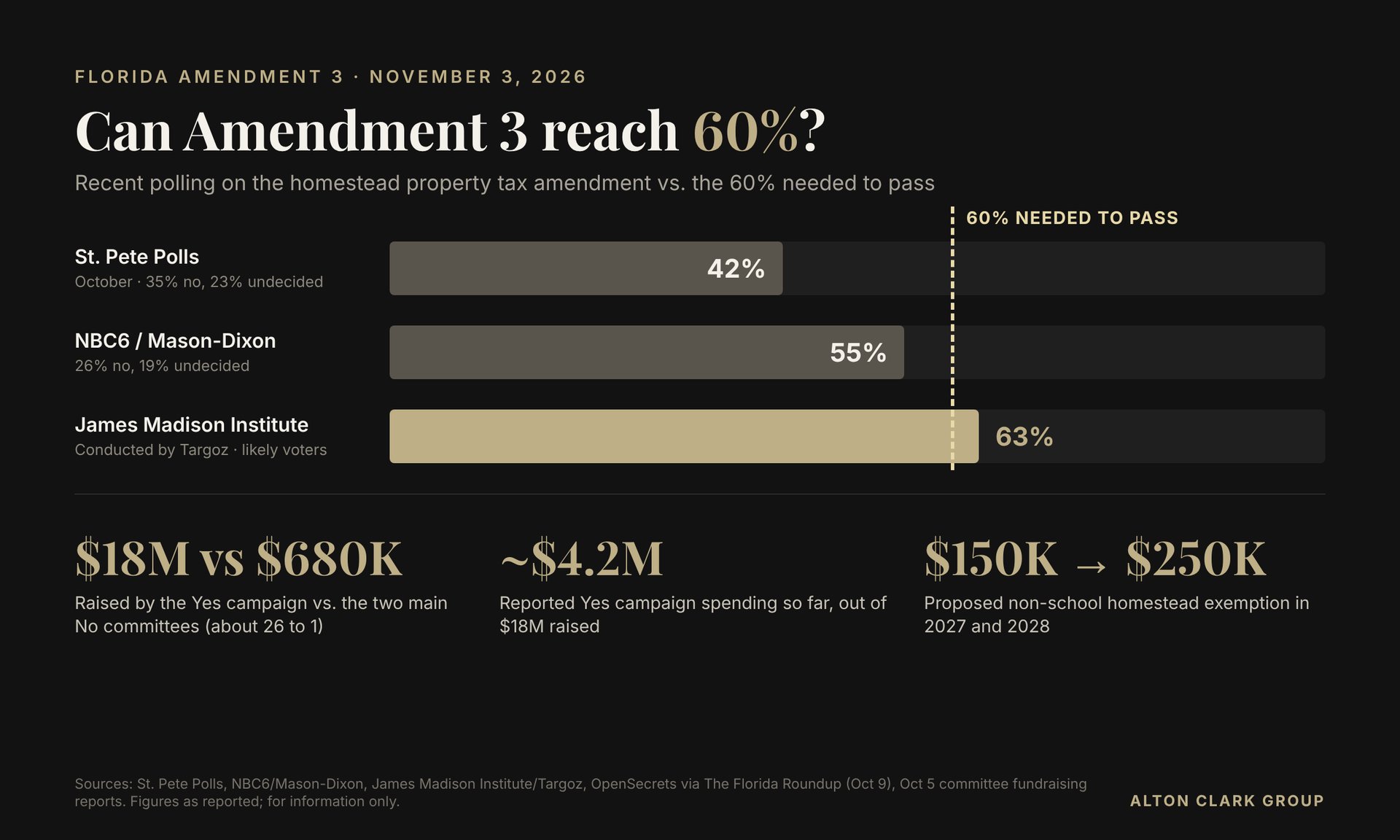
The Vote Yes on 3 campaign has raised about $18 million, largely from Florida Realtors, but an OpenSecrets researcher reported roughly $4.2 million in Yes-side spending so far. Raised and spent are two very different numbers. The two main No committees, Vote No on 3 Florida and Floridians for Shared Prosperity (which sponsors the Save Our Services campaign), had raised around $680,000 as of early October. That's a fundraising edge of about 26 to 1 for the Yes side. Money buys advertising, but it can't guarantee 60%.
Savings vs. Services
Voters are weighing two questions at once. The Yes message is simple: a lower property tax bill. The No message asks what happens to the services property taxes help pay for, like police, fire, and EMS, and whether other taxes or fees could rise to make up the difference. Those are warnings about what could happen, not proof that every community will make the same choices. But uncertainty carries real weight when people decide how to vote.
Why the Polls Disagree
The polls are all over the map. An October St. Pete Polls survey showed 42% support, 35% opposed, and 23% undecided. NBC6 and Mason-Dixon found 55% support, 26% opposed, and 19% undecided. A James Madison Institute survey conducted by Targoz showed 63% support among likely voters, which would clear the bar. These polls reached different voter groups and used different methods, so they shouldn't be read as one steady slide. Undecided voters aren't automatic no votes either. In the Mason-Dixon poll, the Yes side needs five more points, and 19 points of undecided voters are still available. If current supporters hold, winning just over a quarter of those undecided voters gets it to 60.
So, Is Amendment 3 Dying?
Some polling shows real trouble, and other polling shows a path to passage. Right now its future is unsettled, and the undecided voter may decide it. If you own a home in Central Florida and want to understand how Amendment 3 could affect your property, your taxes, or your plans to buy or sell, reach out to the Alton Clark Group. We'll keep tracking the polls and the numbers through Election Day.